Showing posts with label shepherd. Show all posts

Sunday, October 4, 2020

October 2020 - Psalm 23

 Psalm 23: The Lord Is My Shepherd (ESV)


The Lord is my shepherd; I shall not want.

He makes me lie down in green pastures.

He leads me beside still waters.

He restores my soul.

He leads me in paths of righteousness

for his name’s sake.

Even though I walk through the 

valley of the shadow of death,

I will fear no evil,

for you are with me;

your rod and your staff, they comfort me.

You prepare a table before me

in the presence of my enemies;

you anoint my head with oil;

my cup overflows.

Surely goodness and mercy shall follow me

all the days of my life,

and I shall dwell in the house of the Lord

forever.


One of my favorite Psalms is Psalm 23 (22 in some translations). Many years ago, I was introduced to it by my teacher in a public elementary school. Our teacher began the day with our saluting the flag and then reciting Psalm 23 together. It has remained a source of inspiration and comfort throughout my life.

While I ministered in the Navajo Nation, I was blessed with the privilege of observing shepherds caring for their sheep. I also remember one shepherdess sharing that she was getting older and did not know how much longer she could care for her beloved sheep. She was discerning which one of her family members to whom she would entrust the care of the sheep when she could no longer give them the love and attention they needed. Her concern was that she choose one who would become a good shepherd or shepherdess who would be watchful, patient, and have a special, caring relationship with each individual animal.

Sheep are very dependent on their shepherds and sheepdogs (sometimes llamas) because of their limitations.  Sheepdogs, e.g., Australian Shepherd dogs, are very intelligent. I have observed them helping the sheep cross a road safely.

******************************

Psalm 23 is believed to have been authored by David around 1000 B.C.  Let us pause to listen carefully to the words:

The Lord is my shepherd: I shall not want He makes me lie down in green pastures. The shepherd seeks out good pastures for the sheep to graze and leads them there. 

He leads me beside still waters. Since sheep are easily frightened, the shepherd avoids loud waterfalls and finds quiet waters so they can drink peacefully. He restores my soul.

He leads me in paths of righteousness for his name’s sake.

Then, the psalmist says the Lord also guides him in the ways of “righteousness” (goodness).  

Even though I walk through the valley of the shadow of death, I will fear no evil for you are with me; your rod and your staff. They comfort me. 

Some of the paths the sheep have to travel to be pastured are very dangerous.  There are steep mountains to climb and treacherous valleys, but the sheep are never alone.

The staff, like a cane with a rounded hook, is used by the shepherd to test the ground ahead of the sheep to see if it is secure. Sometimes the brush on the side of the mountains hides the danger of loose rocks and the edge of the cliffs.  The shepherd guides the sheep away from the precipices. However, sometimes a wandering sheep loses its way and becomes caught in the brush or slips into a crevice. The shepherd can sometimes rescue the sheep, using the hook end of the staff. (Today, Bishops carry a staff to symbolize that they are to be shepherds of their flock.)

The rod, a thick stick or bunch of twigs, is used to ward off dangerous animals who might attempt to harm the sheep. It can also be used to push back thick brush in the pathway: the rod and the staff help to make the sheep feel safe. The shepherd provides a safe and pleasant pasture for the sheep by watching for dangerous animals and being prepared to get rid of them so the sheep can graze peacefully.

You anoint my head with oil;

Unlike some animals, the sheep cannot rid themselves of insects who might attack their heads, so the shepherds rub their heads with oils that ward off insects.

My cup overflows.

The sheep’s hearts are overflowing with happiness.

Surely goodness and mercy shall follow me all the days of my life,

Having such a loving and caring Shepherd as the Lord, he trusts that he will be cared for in this life.

And I shall “dwell” in the house of the Lord forever.

When called to his heavenly home, he exclaims that he will live joyfully with his Shepherd Lord forever.


Comments:

Stephanie Morris, ASBS, Ph.D. Historian, Certified Archivist, Emerita 
The Infant King was first manifested to shepherds. Shepherds were not the elite of Jewish society. They worked outdoors and their duties were 24/7 - sheep needed care every day. No matter our own status, each of us is called to be a shepherd. We can guard any soul entrusted to us, guiding them to a closer relationship with God. We can guide anyone we meet to a more joyful, peaceful relationship with God. This is a 24/7 call - we never know when the Holy Spirit might prompt us to do something - large or small - for someone.


Pat Chiaffa, ASBS

Psalm 23 has been a source of comfort to me since I was a child. My parents divorced when I was eight-years old; my world was turned upside down. I had to get used to living without my dad and shortly thereafter, adjust to living with a stepfather. The situation left me very frightened.  I would close my eyes and call to mind the gentleness of the shepherd and pretend I was the sheep he placed on his shoulders. It brought me great peace. That same meditation comforts me today as I struggle to grasp the fragile reality of our world. I find myself distressed over the lack of leadership across the globe, the growing violence, shattered economy, crushed dreams and the plight of so many displaced people. I am saddened beyond words at the fear (of Covid 19) that is paralyzing countless people, contributing to anxiety and depression and the loss of bonds of connection and spiritual nourishment. This past weekend I was on a retreat which annually welcomes three hundred participants, the majority of whom have been coming for decades. This year the count was under thirty. Two hundred, seventy women missed powerful messages of God’s tender love, compassion and mercy, and the opportunities to relax, reset and receive the dynamic inspiration that is palpable in such a Spirit-filled environment. 

I believe that the Good Shepherd is calling us to co-shepherd our fellow “sheeples” during these turbulent times. In spite of masking up, we need to speak out of the Presence of God and reach out with words of encouragement and hope. The Presence of God is invisible as is the virus. Yet, the media sustains fear by bombarding the public with details of the virus. It is a challenge to turn off the media info etched in our heads long enough to enter into a quiet place to pray and find rest and hear the gentle whispering of the Holy Spirit to soothe our troubled souls. We need to communicate the message of faith by focusing on and expressing the love, Presence and power of God. Faith drives out fear. The image of the Good Shepherd as described in Psalm 23 is a very effective meditation to foster peace, restore calm and trust in God’s loving Providence.

Monday, May 6, 2019

May 12, 2019 - The Voice of the Good Shepherd

Fourth Sunday of Easter


Images by David Hadfield
Reading I: 
Acts 13:14, 43-52

Psalm:  100

Reading II:  Revelations
7:9, 14b-17

Gospel: 
John 10: 27-30

At the Last Supper, when Jesus is preparing the disciples for his departing from them, he tells them not be worried or upset because He is going to prepare a place for them in his Father’s house. He further explains that He will return and take them to Himself, so that  they will be where He is. Then He tells them: “You know the way that leads to the place where I am going.” (John 14:4).

Thomas responds, “Lord we do not know where you are going; so how can we know the way to get there?”  Jesus answers him: “I am the way, the truth, and the life.” (John 14:6).

If Jesus is the “Way,” we are to follow Him, by living as He did. It is noticeable that Jesus sometimes quotes or refers to passages from the Hebrew Scriptures. From childhood, He has been listening so deeply to the words of Scripture that He quotes or makes connections to them at special times in His life.

This is evident in some of the words of Jesus during his Passion, but also I can see the influence of  the words of the Prophet Ezekiel who quotes Yahweh (the Lord) referring to Himself in saying:

    As a shepherd keeps all his flock in view, when he stands up in the middle
    of his scattered sheep, so shall I keep my sheep in view... I myself will
    pasture my sheep, I myself will show them where to rest — it is the Lord

    Yahweh who speaks — I shall look for the lost one, bring back the stray,
    bandage the wounded and make the weak strong.  I shall watch over the
    fat and healthy. I shall be a true shepherd to them.
(Ezek 34:12, 15, 16).


In today’s Gospel we find Jesus describing his loving and caring relationship to His sheep also:
   
     Jesus said: “My sheep hear my voice; I know them, and they follow me,
     I give them eternal life, and they shall never perish. No one can take them
     out of my hand.  My Father who has given them to me, is greater than all,
     and no one can take them out of the Father’s hand. The Father and I are
     one.” 
 (John 10:27-30)

As we try to follow Jesus, it is important that we study the prophecies and the wisdom in the Hebrew Scriptures, as well as the life and example of  Jesus and His followers in the Christian Scriptures. In moments of silent prayer, if we listen for what the Lord is saying to us through the Sacred Scriptures, we will find our path to heaven by following Jesus, the “Way”.  How blessed are we to have such a loving and caring God!!!
             
Psalm 23 English Standard Version (ESV)

The Lord Is My Shepherd

A Psalm of David


The Lord is my shepherd; I shall not want.
   He makes me lie down in green pastures.

He leads me beside still waters.
   He restores my soul.

He leads me in paths of righteousness
   for his name's sake.

Even though I walk through the valley of the shadow of death, 
   I will fear no evil,
for you are with me;
   your rod and your staff,
   they comfort me.

You prepare a table before me 
   in the presence of my enemies;
my cup overflows.

Surely goodness and mercy shall follow me
   all the days of my life,
and I shall dwell in the house of the Lord
   forever.    


  Reflection Question:    Some hear the voice of the Lord clearly in the Holy Bible. Others hear the voice of the Lord more clearly in Nature. Some hear him in the circumstances of their lives. Others hear him in music or art. Where and when do you hear the voice of the Lord most clearly?


Spanish Translation of Reflection Above...
La Voz del Buen Pastor


En la Última Cena, cuando Jesús está preparando a los discípulos para que se aparten de ellos, les dice que no se preocupen ni se molesten porque les va a preparar un lugar en la casa de su Padre. Además, explica que regresará y se los llevará a sí mismo, para que estén donde está. Luego les dice: “Ya sabes el camino que lleva al lugar donde voy”. (Juan 14:4).

Thomas responde, “Señor, no sabemos a dónde vas; Entonces, ¿cómo podemos saber el camino para llegar allí?”  Jesús le responde: “Yo soy el camino, la verdad y la vida”. (Juan 14:6).

Si Jesus es el “Camino,” debemos seguirlo, viviendo como él lo hizo. Es notable que Jesús a veces cita o se refiere a pasajes de las Escrituras hebreas. Desde la niñez, Él ha estado escuchando tan profundamente las palabras de las Escrituras que Él cita o hace conexiones con ellas en momentos especiales de Su vida.

Esto es evidente en algunas de las palabras de Jesús durante su Pasión, pero también puedo ver la influencia de las palabras del profeta Ezequiel que cita Yahvé (El Señor) refiriéndose a sí mismo al decir:

    Como un pastor mantiene todo su rebaño a la vista, cuando se para en
    el medio
 de sus ovejas dispersas, así mantendré mis ovejas a la vista ...
    yo mismo pastaré

    Mis ovejas, yo mismo les mostraré dónde descansar: es el Señor.
    Yahvé que habla: Buscaré al perdido, traeré de vuelta el camino perdido.
    Venda a los heridos y haga fuertes a los débiles. Velaré por la grasa
    y saludable. Seré un verdadero pastor para ellos. (Ezek 34:12, 15, 16).

En el Evangelio de hoy encontramos a Jesús describiendo su relación amorosa y afectuosa con Sus ovejas también:
 
     Jesus dijo: “Mis ovejas oyen mi voz; Yo las conozco y ellas me siguen,
     Yo les doy vida eterna, y nunca perecerán. Nadie puede tomarlos
     fuera de mi mano Mi Padre que me las dio, es mayor que todos.
     y nadie puede sacarlos de la mano del Padre. El Padre y yo somos uno”.
    (Juan 10:27-30)

Al tratar de seguir a Jesús, es importante que estudiemos las profecías y la sabiduría en las Escrituras hebreas, así como la vida y el ejemplo de Jesús y sus seguidores en las Escrituras cristianas. En momentos de oración silenciosa, si escuchamos lo que el Señor nos está diciendo a través de las Sagradas Escrituras, encontraremos nuestro camino al cielo siguiendo a Jesús, el  “Camino”. ¡Cuán bendecidos somos de tener un Dios tan amoroso y amoroso!
             
Salmo 23  Versión Estándar en Inglés (ESV)

El Señor es Mi Pastor

Un Salmo de David

El señor es mi pastor; Nada me faltará.
   Me hace recostar en verdes prados.

Me lleva junto a aguas tranquilas.
   Él restaura mi alma.

Me guía por sendas de justicia
   por el bien de su nombre.

Aunque ande por el valle de la sombra de la muerte,
   No temeré ningún mal,
porque tú estás conmigo;
   tu vara y tu vara,
   me consuelan

Tu preparas una mesa delante de mi
   en presencia de mis enemigos;
mi copa se desborda

Ciertamente el bien y la misericordia me seguirán.
   todos los días de mi vida,
y habitaré en la casa de Jehová.
   Siempre.
 
  Pregunta de reflexión:   

Algunos escuchan la voz del Señor claramente en la Santa Biblia. Otros escuchan más claramente la voz del Señor en la Naturaleza. Algunos lo escuchan en las circunstancias de sus vidas. Otros lo escuchan en la música o en el arte. ¿Dónde y cuándo escuchas más claramente la voz del Señor?

Monday, November 19, 2018

Nov. 25, 2018 Christ the King

The Feast of  Christ the King    -   Year B

Reading I:  Daniel 7: 13-14

Psalm:  93

Reading II: Revelation 1:5-8

Gospel: John 18: 33b-37

“Thy kingdom come!” I can recall many years ago feeling overwhelmed as I prayed the “Our Father.” However, it seems even more of a challenge today with all the hate and violence we hear about on a regular basis.

I can vividly recall an evening back in the 70’s when I taught at Aquinas Junior College in Newton, Massachusetts. It was the end of the year, and we 
took the students to the Boston Pops. After the Pops, the faculty stopped at a restaurant to have coffee and a snack. I was sitting at a table with a Jewish faculty member who had recently heard of some unrest related to Jews in the Mid-West. She was terrified. I was shocked that she would be so upset living here in the United States.

After the murder of worshipers at the Tree of Life Synagogue, I certainly understand her fear and realize how naive I was. It seems that daily we see 
a world in which cruelty and violence, rather than love, is embraced by so many. It can be very depressing to see this trend in our country.

I was impressed to learn that this synagogue and others have been regularly helping refugees for many years. Like Jesus, the victims were murdered in spite of and because of the good they were doing. Again, I feel frustrated to 
see all the evil in our world.

However, that makes me appreciate the Lord Jesus all the more. He knew that the kingdom of His Father on this earth would be found in the hearts of some, but rejected by others. Nevertheless, He was willing to offer Himself up for the salvation on all. As Jesus’ followers, we can choose Jesus as the King of our hearts. We can 
make “Love” our goal and “go about doing good” as He did, whether we will gain acceptance or rejection as a result. Jesus did what He could and that is
all that we can do. In
us, at least, the Father’s kingdom will come and His will,
will be done.


 Reflection: 

You may hear this hymn on 
GodTube.


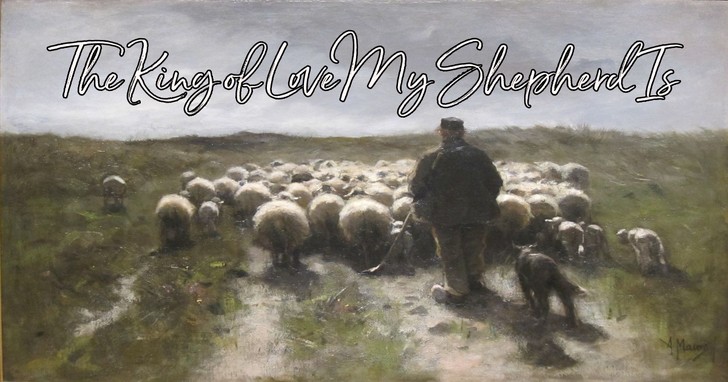
 The King of Love My Shepherd Is

“The King of Love My Shepherd Is” is an 1868 hymn with lyrics written by Henry Baker, based on the Welsh version of Psalm 23 and the work of Edmund Prys. Obvious from its title, this hymn plays upon the metaphor of Jesus as a shepherd leading his followers from evil and despair towards salvation. Find the lyrics and story of this wonderful hymn below!
4 In death's dark vale I fear no ill,
with thee, dear Lord, beside me;
thy rod and staff my comfort still,
thy cross before to guide me.

5 Thou spreadst a table in my sight;
thy unction grace bestoweth;
and oh, what transport of delight
from thy pure chalice floweth!

6 And so through all the length of days,
thy goodness faileth never;
Good Shepherd, may I sing thy praise
within thy house forever.


Spanish Translation of Reflection Above...

Cristo Rey


“¡Venga tu reino!” Puedo recordar que hace muchos años me sentí abrumado mientras rezaba el “Padre Nuestro”. Sin embargo, hoy parece un desafío aún mayor con todo el odio y la violencia que escuchamos de manera regular.

Puedo recordar vívidamente una tarde en los años 70 cuando enseñé en el Aquinas Junior College en Newton, Massachusetts. Era el final del año, y llevamos a los estudiantes a los Boston Pops. Después de los Pops, la facultad se detuvo en un restaurante para tomar un café y un bocadillo. Estaba sentado en una mesa con un miembro de la facultad judía que recientemente había oído hablar de algunos disturbios relacionados con los judíos en el Medio Oeste. Ella estaba aterrorizada. Me sorprendió que ella estuviera tan molesta viviendo aquí en los Estados Unidos.

Después del asesinato de adoradores en la Sinagoga del Árbol de la Vida, ciertamente entiendo su miedo y me doy cuenta de lo ingenua que era. Parece que todos los días vemos un mundo en el que la crueldad y la violencia, en lugar del amor, son abrazadas por tantos. Puede ser muy deprimente ver esta tendencia en nuestro país.

Me impresionó saber que esta sinagoga y otras han estado ayudando regularmente a los refugiados durante muchos años. Al igual que Jesús, las víctimas fueron asesinadas a pesar y por el bien que estaban haciendo. Una vez más, me siento frustrado de ver todo el mal en nuestro mundo.

Sin embargo, eso me hace apreciar aún más al Señor Jesús. Sabía que el reino de Su Padre en esta tierra se encontraría en los corazones de algunos, pero que otros lo rechazarían. Sin embargo, Él estaba dispuesto a ofrecerse a sí mismo para la salvación de todos. Como seguidores de Jesús, podemos elegir a Jesús como el Rey de nuestros corazones. Podemos hacer que “Amar” sea nuestra meta y “seguir haciendo el bien” como Él lo hizo, ya sea que ganemos aceptación o rechazo como resultado. Jesús hizo lo que pudo y eso es todo lo que podemos hacer. Inus, al menos, el reino del Padre vendrá y su voluntad, se hará.

 Reflexión: 

Puede escuchar este himno en GodTube.


“El Rey del Amor es mi Pastor” es un himno de 1868 con letras escritas por Henry Baker, basado en la versión galesa del Salmo 23 y la obra de Edmund Prys. Obvio de su título, este himno toca la metáfora de Jesús como un pastor que guía a sus seguidores del mal y la desesperación hacia la salvación. ¡Encuentra las letras y la historia de este maravilloso himno a continuación!
4 En el valle oscuro de la muerte no temo ningún mal,
Contigo, querido Señor, a mi lado;
Tu vara y mi bastón aún mi consuelo,
Tu cruz antes de guiarme.

5 Extiendes una mesa delante de mí;
tu gracia de unción otorga;
y oh, qué transporte de deleite.
de tu puro cáliz fluye!

6 Y así a lo largo de todos los días,
tu bondad nunca deja de ser;
Buen Pastor, que yo cante tu alabanza.
Dentro de tu casa para siempre.

Monday, July 16, 2018

Our Compassionate Shepherd - July 22, 2018

The Sixteenth Sunday in Ordinary Time - Year B
Reading I:  Jeremiah 23: 1-6

Psalm:  23

Reading I:  Ephesians 2: 13-18

Gospel:  Mark 6: 30-34


In today’s Gospel, we observe our compassionate Shepherd, Jesus, caring both for his apostles who had just returned from preaching the Good News and the people who were following them. Realizing the how exhausted and hungry the apostles were, Jesus invited them to “come apart and rest a while.” 

They attempted to remove themselves from the crowds by going off in a boat. However, the crowds managed to find out where they were going and traveled on foot to join them. Jesus’ concern also extended to these people who were longing for the Good News being given to them. Jesus saw them in need of hope and care so as tired as He was, He Himself, began to teach them.

Jesus was truly a compassionate shepherd. While some of us have a sense of what was involved in shepherding here in the United States in modern times, it is not exactly the way shepherding was done in Jesus’ time and place.

The late Archbishop Joseph Cassidy of Tuam, Ireland, in his book, These Might Help points out some special aspects of shepherding from the time of Jesus. First, the shepherd did not just check on the sheep morning and evening, leaving them in the care of dogs or llamas. They stayed with them all day, and then, at night, brought them into a sheepfold to protect them from animals who might attack and kill them. Often the shepherd would sleep at the door of the enclosure to make sure no predator would sneak into the sheepfold.

Another unique factor is that instead of driving the sheep ahead of them, the shepherd would lead them. He would go ahead of them to check for safety, etc. The cane-like stick he carried would be used to test the ground ahead to make sure it was stable so that the sheep would not fall down a mountain or into a crevice. The hook at the end was to rescue the sheep if they were falling or stuck. In other words, it was for their safety, a sign that they were being cared for by the shepherd. Today, our bishops carry a similar item called a “crosier,” symbolizing their roles as shepherds of the people in their dioceses.

Finally, the shepherds gave each sheep a name and knew each one as an individual with unique personalities and needs. So, our Good Shepherd relates to each one of us as unique individual creations of a loving God.

 This Week’s Reflection:  

How blessed we are that Jesus has an intimate knowledge of each one of us!
How blessed we are that we have a God who understands us completely!

How blessed we are to have a God of compassion, feeling deeply with us!
  

What an awesome God have we !!!  How greatly blessed are we!!!

Praise the Lord!  Praise his Holy Name! 


Spanish Translation of Reflection Above...
Our Compassionate Shepherd


En el Evangelio de hoy, observamos a nuestro compasivo Pastor, Jesús,
que se preocupa por sus apóstoles que acaban de regresar de predicar las Buenas Nuevas y las personas que los seguían. Al darse cuenta de cuán agotados y hambrientos estaban los apóstoles, Jesús los invitó a “apartarse y descansar
un rato”.

Intentaron alejarse de la multitud yendo en un bote. Sin embargo, las
multitudes lograron averiguar a dónde iban y viajaron a pie para unirse a ellos.
La preocupación de Jesús también se extendió a estas personas que anhelaban
que se les diera la Buena Noticia. Jesús los vio necesitado de esperanza y cuidado, tan cansado como Él, Él mismo, comenzó a enseñarles. Jesús fue verdaderamente un pastor compasivo. Mientras que algunos de nosotros tenemos un sentido de lo que estaba involucrado en el pastoreo aquí en los Estados Unidos en los tiempos modernos, no es exactamente la forma en que se hizo el pastoreo en el tiempo y el lugar de Jesús.

El difunto arzobispo Joseph Cassidy de Tuam, Ireland, en su libro, These Might Help, señala algunos aspectos especiales del pastoreo desde el tiempo de Jesús. Primero, el pastor no se limitó a controlar a las ovejas por la mañana y por la noche, dejándolas al cuidado de perros o llamas. Se quedaron con ellos todo el día, y luego, por la noche, los llevaron a un redil para protegerlos de los animales que podrían atacarlos y matarlos. A menudo, el pastor dormía en la puerta del recinto para asegurarse de que ningún depredador se colaría en el redil.

Otro factor único es que en vez de conducir a las ovejas delante de ellas, el pastor las guiaba. Él iría delante de ellos para verificar la seguridad, etc. El bastón como bastón que llevaba se usaría para probar el terreno que se encuentra delante para asegurarse de que era estable, de modo que las ovejas no cayeran por una montaña o en una grieta. El gancho al final era rescatar a las ovejas si se caían o se atascaban. En otras palabras, era por su seguridad, una señal de que estaban siendo cuidados por el pastor. Hoy, nuestros obispos llevan un artículo similar llamado “báculo”, que simboliza sus roles como pastores de las personas en sus diócesis.

Finalmente, los pastores le dieron un nombre a cada oveja y conocieron a cada una como un individuo con personalidades y necesidades únicas. Entonces, nuestro Buen Pastor se relaciona con cada uno de nosotros como creaciones individuales únicas de un Dios amoroso.


 Reflexión de esta semana:
  

¡Cuán bendecidos somos porque Jesús tiene un conocimiento
íntimo de cada uno de nosotros!

¡Qué bendecidos somos porque tenemos un
Dios que nos comprende por completo!

¡Cuán afortunados somos de tener un Dios de compasión,
sintiéndonos profundamente con nosotros!

¡Qué Dios tan maravilloso tenemos nosotros!
¡Cuán bendecidos somos!
                                       
¡Alabado sea el Señor! ¡Alabado sea su Santo Nombre!

Monday, April 16, 2018

I Am the Good Shepherd - April 22, 2018

The Fourth Sunday of Easter  -  Year B

Reading I:   Acts 4:8-12

Psalm:  118

Reading II:  1 John 3:1-2

Gospel:  John 10: 11-18


Our beautiful image of Jesus as our Shepherd has many aspects for reflection. We relish the very close relationship
between the sheep and the shepherd.
The sheep depend on their shepherd
for their food, their comfort and
their safety.


Unlike many other animals, the sheep are not likely to be able to survive on their own. Therefore, the shepherd leads the sheep to green pastures for grazing and calm waters to quench their thirst. Since sheep are not flexible enough to rid themselves of insects which attack their heads, the shepherd covers the heads of the sheep with oil to protect them.

When the sheep are being led along the sides of mountains, there is the danger that they will fall over the edge. The shepherd goes ahead of them tapping the grounds  to make sure they are secure before allowing the sheep to walk over them. In spite of this, sometimes a wandering sheep will get caught in bushes or go too close to the edge and fall over. The staff that the shepherd carries has a hook on the end which the shepherd can use to rescue a sheep that is in trouble. With all the care required, the sheep are closely connected to the shepherd.

Finally, the sheep are the prey of many animals, so the shepherd carries a rod (club) to ward off their attackers. In the evening, they are corralled and the shepherd watches over them, sometimes laying across the door of the corral to prevent anyone's stealing or harming the sheep. The shepherd who owns the sheep is willing to give up his life to save them.

Jesus describes himself as the Good Shepherd. We belong to Him and because of His close relationship with us, He willingly gave up His life for us.

 In his book, Who Is Christ?, Anthony Padovano wrote:

We are saved not by the physical death of Jesus, but by the absoluteness of a love which did not count death too high a price.

 Reflection Question:   When Peter declared his love for Jesus, Jesus asked him to feed His lambs and sheep. Is there a lamb or sheep that you think the Lord is asking you to care for in a special way?


Spanish Translation of Reflection Above...
Soy el Buen Pastor


Nuestra bella imagen de Jesús como nuestro Pastor tiene muchos aspectos para la reflexión. Disfrutamos de la relación muy estrecha entre las ovejas y el pastor. Las ovejas dependen de su pastor para su alimento, su comodidad y su seguridad.

A diferencia de muchos otros animales, es poco probable que las ovejas puedan sobrevivir por sí mismas. Por lo tanto, el pastor lleva a las ovejas a pastos verdes para pastoreo y aguas tranquilas para saciar su sed. Como las ovejas no son lo suficientemente flexibles como para librarse de los insectos que atacan sus cabezas, el pastor cubre las cabezas de las ovejas con aceite para protegerlas.

Cuando las ovejas son conducidas a lo largo de los lados de las montañas, existe el peligro de que caigan por el borde. El pastor va delante de ellos tocando los terrenos para asegurarse de que están seguros antes de permitir que las ovejas pasen por encima de ellos. A pesar de esto, a veces una oveja vagabunda queda atrapada en los arbustos o se acerca demasiado al borde y se cae. El bastón que lleva el pastor tiene un gancho en el extremo que el pastor puede usar para rescatar a una oveja que está en problemas. Con todo el cuidado requerido, las ovejas están estrechamente conectadas con el pastor.

Finalmente, las ovejas son presa de muchos animales, por lo que el pastor lleva una vara (bastón) para protegerse de sus atacantes. Por la noche, están acorralados y el pastor los vigila, a veces cruzando la puerta del corral para evitar que alguien robe o dañe a las ovejas. El pastor que posee la oveja está dispuesto a renunciar a su vida para salvarlos.

Jesús se describe a sí mismo como el Buen Pastor.  Le pertenecemos a Él y debido a su estrecha relación con nosotros, voluntariamente entregó su vida por nosotros.

En su libro,  ¿Quién es Cristo?, Anthonio Padovano escribió:

Somos salvados no por la muerte física de Jesús, pero por lo absoluto muerte demasiado alto precio de un amor que no cuenta.


 Pregunta de reflexión:    Cuando Pedro declaró su amor por Jesús, Jesús le pidió que le diera de comer a sus corderos y ovejas. ¿Hay un cordero u oveja que piensas que el Señor te está pidiendo que cuides de una manera especial?

Monday, June 26, 2017

Hospitality - July 2, 2017


The Thirteenth Sunday of Ordinary Time  A

Reading I:  2 Kings 4:8-11,14-16a

Psalm: 89

Reading II: Romans 6:3-4, 8-11

Gospel:  Matthew 10:37-42

This Sunday’s readings are all about hospitality. The Hebrew Scripture describes the generous hospitality shown to the prophet 
Elisha by the woman from Shunem and her husband who provided not only food but also a room for Elisha during his travels.

Then Matthew in his Gospel quotes Jesus saying: “Whoever receives you receives me, and whoever receives me receives the one who sent me. And whoever gives only a cup of cold water to one of these little ones...will surely not lose his reward.” 

There are many definitions of hospitality and many ways it can be expressed. It is basically friendliness and caring. It can range from providing food and shelter to listening to someone who is troubled.
It can range from helping provide clean water in places where people die from disease-infected water to offering a cup of tea to a friend.

Whatever form it takes, it involves setting aside one’s own interests
and focusing on the needs of another. That can be a challenge as we now live in such a fast-paced world. Surrounded by so many
needs, including our own legitimate needs, we can sometimes become overwhelmed. That is when we need to carve out some special time to be with the Lord. 

We need to ask the Lord’s guidance regarding what He wants of us.
He may simply affirm the many ways we are already showing hospitality or He may call us to extend ourselves more. He may even ask us to put the persons in His hands if we are overextended.
We just need to open our hearts to listen deeply in silence to our Shepherd and follow His lead.


Spanish Translation of Reflection Above...

Hospitalidad


Las lecturas de este domingo tratan de la hospitalidad. La Escritura Hebrea describe la generosa hospitalidad mostrada al profeta
Eliseo por la mujer de Shunem y su esposo que no sólo le proporcionó comida sino también un espacio para Eliseo durante sus viajes.

Entonces Mateo en su Evangelio cita a Jesús diciendo: “El que te recibe me recibe a mí, y el que me recibe recibe al que me envió. Y el que da sólo una taza de agua fría a uno de estos pequeños ... seguramente no perderá su recompensa.”

Hay muchas definiciones de la hospitalidad y muchas maneras que se pueden expresar. Es básicamente simpatía y cariño. Puede variar desde proveer comida y refugio hasta escuchar a alguien que está preocupado. Puede ir desde ayudar a proporcionar agua limpia en lugares donde la gente muere de agua infectada por la enfermedad hasta ofrecer una taza de té a un amigo.

Sea cual sea la forma que adopte, implica apartar los propios intereses y centrándose en las necesidades de otro. Eso puede ser un desafío ya que ahora vivimos en un mundo tan acelerado. Rodeado de tantos Necesidades, incluyendo nuestras propias necesidades legítimas, a veces podemos ser abrumados. Es entonces cuando necesitamos tener un tiempo especial para estar con el Señor.

Necesitamos pedir la guía del Señor con respecto a lo que El quiere de nosotros. Puede simplemente afirmar las muchas maneras en que ya estamos mostrando hospitalidad o Él puede llamarnos para extendernos más. Incluso puede pedirnos que pongamos las personas en Sus manos si estamos excesivamente extendidos.
Sólo necesitamos abrir nuestros corazones para escuchar profundamente en silencio a nuestro Pastor y seguir Su ejemplo.

Thursday, September 8, 2016

September 11, 2016 - The Prodigal Son

The Twenty-fourth Sunday in Ordinary Time - Year C

Image result for the prodigal son

Reading I: Exodus 32: 7-11, 13-14
Response: Psalm 51: 3-4, 12-13, 17,19
Reading II: Timothy 1:12-17
Gospel: Luke 15: 1-32


This Sunday’s readings are again about mercy. Fr. Hans Urs von Balthasar in his book, Light of the Word, uses the expression that mercy is the “innermost attitude” of God. He quotes Timothy’s Epistle: “If we are faithless, he remains faithful, for he cannot deny himself.”
(2 Tim 2:13)

God does not just give mercy when we come to Him. He goes after us. We see this in the parable of the lost sheep when the shepherd leaves the ninety-nine and goes in search of one lost sheep. Then, we see the woman looking for the lost coin. The father of the prodigal son watches for the return of his son and runs to greet him, embraces him, kisses him and orders his servants to prepare for a celebration of his son's return.

Francis Thompson wrote a beautiful poem in which he describes God as “The Hound of Heaven.” I can still remember Bishop Sheen reciting the poem on his television show.

Even without the dramatic voice of Bishop Sheen, it is a powerful poem which brings out the 
extravagance of God's Love. The whole poem is beautiful, but very long. Therefore, I am quoting only the beginning.  
The Hound of Heaven
By Francis Thompson  (1859–1907)
  
I FLED Him, down the nights and down the days;
  I fled Him, down the arches of the years;
I fled Him, down the labyrinthine ways
    Of my own mind; and in the mist of tears
I hid from Him....


To view the entire poem, click the title link.

What an awesome God we have! His goodness is beyond our understanding. He could well be called the “prodigal father” for He is lavish, unsparing, and bounteous in His love.

How blessed we are!!! Let us praise the Lord and bless his holy name! He only asks of us to imitate Him by extending love and mercy to our brothers, sisters, and ourselves.

Gerald Darring, of St. Louis University, challenges us to mercy for our brothers and sisters in prison. Today, we are seeing people released from death's row now that DNA tests can more accurately determine whether a person has committed murder. In the spirit of mercy, Gerald Darring reminds us of the “Statement on Capital Punishment” announced by the U.S. Bishops
in 1980:

                         Abolition of capital punishment is a manifestation of our belief
                         in the unique worth and dignity of each person from the moment
                         of conception, a creature made in the image and likeness of God.
                         It is particularly important in the context of our times that this
                         belief be affirmed with regard to those who have failed or whose
                        lives have been distorted by suffering or hatred, even in the case
                        of those who by their actions have failed to respect the dignity and
                        rights of others.

Mercy would require attempts at rehabilitating prisoners. In addition, when a prisoner is released, we need to provide some assistance in finding a job and housing. Even those who might be considered unsafe to release can be treated humanely as they remain in prison.

How can we, who have received mercy from the Lord, extend mercy to his beloved children?