Sunday, January 31, 2021

5th Sunday in Ordinary Time - B


Reading I - Job 7:1-4, 6-7

Psalm - 47

Reading II - 1 Cor 9:16 -19, 22-23

Gospel - Mark 1:29-39

As I reflect on the readings for today's liturgy, I am struck by the fact that in this "ordinary time" of the Church Year, we are experiencing an extraordinarily difficult time. However, the readings include both. 

In the first reading from the Book of Job in the Hebrew Scriptures (Old Testament), we meet Job, a good man, who is being challenged to decide whether to continue to be a faithful worshiper of God. He is wrestling with the age-old questions: 1) Why does God allow suffering? 2) Why do some suffer so much more than others? 3) If God is so good (Ps. 147), why does he allow evil?

Some of the sentiments expressed by Job are heard by people today during the current Pandemic: "Is not man's life on earth a drudgery?"  "...I have been assigned months of misery, and troubled nights have been allotted to me."

Jesus never answers the questions. In his humanity, he accepts suffering himself and reaches out in love to those suffering around him.  From our own observation, we know that suffering can make us "bitter or better." We observe some who become mean and destructive. On the other hand, we see others who help others in need of goods or comfort. We even see heroic deeds when a person risks his or her own comfort or even life for others.

What must we do to be prepared to be "better" in the ordinary and extraordinary times? In the Christian Scriptures (New Testament), Jesus tells us: "I am the Way, the Truth, and the Life." In today's Gospel, we see Jesus leaving the synagogue after teaching and ordering an evil spirit out of a man. The congregation is astounded with his teaching and his power over the evil spirit.

After observing the Sabbath services, Jesus and his disciples go to visit the home of Simon Peter whose mother-in-law is sick. Jesus heals her, and she provides them with a meal. In the evening, many people needing healing or freedom from evil spirits gather in front of Peter's home and are cured of their ailments.

The next morning Jesus rises early and goes to a private place to pray. His disciples search for him and tell him that everyone is looking for him. Of course, they want him to remain with them. However, Jesus tells his followers that they need to go to the other villages in Galilee, also. Jesus thus signals that he is sent for all peoples.

Jesus has thus shown us the Way! 

I. He participates in Holy Day Services which for him, as a Jewish man, was to attend the Sabbath Services in the Synagogue. For modern Jewish people, they can also attend Sabbath Services. For Christians, it may be to participate in Sunday Mass or Prayer Services in their Church Homes.

II. Then he participates in fellowship with others. He reaches out to those in need of healing, understanding, acceptance, food, e.g. 

                  A.  Healing the blind man and others

                  B. Understanding the Samaritan woman at the well

                  C. Accepting Simon Peter, in spite of his weaknesses

                  D. Feeding the multitude who had been listening to his preaching

                  E. Sacrificing self for others

III. In spite of his busyness, Jesus prioritizes time for personal prayer. Before dawn, he goes to a private place to commune with his Heavenly Father.

IV. He corrects his followers who want him to stay with them. He says that he must go to other villages also to preach to them. 

V.  In our Second Reading from St. Paul, we are reminded that Jesus extends his salvation to the Gentiles ( non- Jews) also.

Jesus shows us how to be our best selves by his example. As Emmanuel, he walks beside us to help us on our way.  Let us remember that we are not alone whether in extraordinary or ordinary times.


Comments

Stephanie Morris, Ph.D. , ASBS, Historian, Certified Archivist, emerita

"Ordinary" sounds so, well, ordinary and dull. "Ordinary" can be defined as uninteresting or commonplace. We know that the Church refers to "Ordinary time" because it is counting the weeks between special holy days.

Sometimes we may wish that we were not "ordinary" folks but wealthy celebrities or business people. Kate Drexel was one of those - the daughter of a millionaire banker. She had great and wonderful things about her in her father's houses and enjoyed the benefits of wealth. But Kate was called to something else.  By accepting her call to religious life, Kate rejected the facade of wealth for a simpler life. Mother Katharine liked "ordinary."  She said it was part of the path to perfection: "Perfection consists in the performance of ordinary duties well." Being content with where she was and what she had to do, Mother Katharine could focus on what God wanted her to be and to do. As the Little Flower, Mother Katharine saw the benefit of ordinary, little things done well.


Pat Chiaffa, ASBS


 As a thank you for a donation made, a charity that I support sent me a pair of socks. They are navy blue with white doves and on the bottom is the saying, “Pray, don’t worry.” I am seriously considering recrafting them into gloves so that the reminder to pray is more visible. As last year’s circumstances carry into this new year, prayer is the number one tool I need to remember that God really has got this in His control. As I write this post, I am one week into a new Bible Study series entitled, “The Armor of God.” We use a workbook, and each day there are Scripture readings and questions on which we are to journal. The focus of this study is Ephesians 6: 10 – 19 which begins with “Put on the full armor of God so that you will be able to stand firm against the schemes of the devil, and ends with, pray…”

The value of this study for me at only day three, is that I recognize that the on-going unsettledness I feel runs much deeper than the visible disruptions I continue to see in lives and businesses in my community, nation, and the world. I realize that the inner disorder I am experiencing is truly spiritual warfare and the armor I need is continual prayer. As St. Paul writes, “With all prayer and petition, pray at all times in the Spirit…” Being in communion with God will enable me to live in this world without becoming a victim to anger, preoccupation, obsession, and addiction.

In your blog, Sr. Annette, you noted several behaviors of Jesus that model ways of One who lives in the way of the Lord. Prayer appears to have been a daily practice for Jesus. He prayed during his activities of healing, prayed with others, taught his disciples how to pray and he also created space for solitary prayer. Scripture gives us several glimpses into Jesus’ going off to a quiet place to be alone with God.  Jesus always credited His Father was the One who brought forth the fruit in his ministry. In the solitude of prayer, Jesus enters into intimacy with his Father. “In solitary prayer, Jesus comes to understand his identity and mission. In prayer, he experiences God’s will and direction, and affirms that it is God who sends him, who gives him the words to say and the deeds to fulfill.” These words of Henri Nouwen, for me, validate the need to discipline myself to spend quiet time with God on a regular basis so I can make the journey from mind to heart, “from unceasing thinking to unceasing prayer.

As we prepare for the Season of Lent, let us commit to discovering God in the center of our being by taking time to sit in solitude and silence. There, in the place of the heart, we can learn the power of interior prayer and hear the voice of the One who calls us “my beloved.”

Monday, December 28, 2020

January 3, 2021 - The Epiphany of Jesus Christ


The Feast of Epiphany celebrates the manifestation of Jesus as Savior for all peoples. The gifts brought by Magi from different countries have very special significance.  The gold reminds us that Jesus is of royal descent since He was of King David's line.  The Frankincense indicates the adoration that is owed to Jesus who is also divine. The myrrh, which was used to anoint the body before burial, calls forth gratitude for Jesus' giving his life to redeem us.


Through the study of Creation, our ancestors could recognize the power and intelligence of God.  However, God, our Father, with the gift of Jesus as a human being, helps us to understand other qualities of God, most especially those of love and mercy.

When we observe the life of Jesus in the New Testament (Christian Scriptures) we develop a deeper understanding of our loving and merciful God. Jesus taught us both by word and example.  His parables (stories to teach a lesson) e.g.  The story of the Prodigal Son who squandered his inheritance and was welcomed back by his merciful father illustrates this.  Jesus' own example of forgiveness of the repentant woman also provides a deeper sense of the merciful kindness of our God. Jesus asks us to show mercy to one another also when he teaches his disciples to pray: "Forgive us our sins as we forgive those who sin against us."

In addition, Jesus instructs us to treat one another as brothers and sisters with a common Heavenly Father. The Jews considered the Samaritans to be inferior because some of them intermarried with Assyrians. In response to a question: "Who is my neighbor?" Jesus offers the parable: "The Good Samaritan."  While others pass by a man who had been injured by robbers,  the Samaritan stops and goes out of his way to help him.

In Jesus' lifetime, women and children were considered to be possessions of men.  Jesus treats women with respect and even converses with a Samaritan woman and asks her for a drink of water.  He could have faced heavy criticism for that.  When the disciples try to send children away because they know Jesus is tired, Jesus stops them and tells them to let the children come to him. He also informs the disciples that unless they become like children, they will not enter the Kingdom of God.

The story of the Magi's travels from distant lands to find their God and King is like the journey of each one of us. The light of the Star is the unique guidance we receive along the way. Sometimes it is a personal inspiration or something we read or comment on or an example of another person. 

Pope John Paul II described the Christian life as a " pilgrimage to the House of God, our Father."

************************************************

A  Christmas Story The Other (Fourth) Wise Man

by Henry Van Dike

A wise man, possibly an astronomer, named Artaban from Persia saw signs in the sky proclaiming that a King had been born among the Jews.  He sets out to see the newborn ruler, bringing with him a sapphire, a ruby, and a "pearl of great price." On his way to meet the other three wise men, he stops to help a dying man and is too late to join the caravan.  He cannot cross the desert with only a horse, so he has to sell one of his treasures to buy some camels and supplies. 

Artaban continues his journey and arrives at Bethlehem too late to see the child because his parents have fled with him to Egypt. They went to Egypt to avoid the threats of King Herod who does not want any competition for power from a new King.  While there, Artaban saves the life of a child by giving away another treasure intended for his King.

Not to be discouraged from finding his King, Artaban travels through a number of countries, doing many kind deeds along the way. He arrives in Jerusalem as Jesus is being crucified.  There, he is struck in the head by a falling roof tile.  As he lays dying, he hears a voice saying: "Verily I say unto thee, inasmuch as thou hast done it unto one of the least of these my brethren, thou hast done it unto me." (Matthew 25:40) Artaban dies in peace and joy, realizing that his treasures of kindness had been accepted lovingly by his King.

 Jesus - Emmanuel - God with us 

One of my favorite names for Jesus heard often during the Christmas Season, is our Emmanuel (Immanuel).  It means "God, with us."  We never really are alone.  We find God in creation,  in the Blessed Sacrament (Holy Communion), in Sacred Scripture, and in one another.

God is present to us through one another.  Although this true at all times, it is most evident when disasters happen, e.g. hurricanes, forest fires, and today during our pandemic. We see our healthcare personnel working long hours providing care and comfort to the sick and dying.  We see essential workers providing food and other needed items and services. Police and firefighters risk their lives to help those in need.  Caring people check on their elderly relatives, friends, and neighbors to provide meals and help when needed.  Volunteers work many hours staffing food banks, etc.  Yes, God is ever-present with us in many ways. Let us express our gratitude daily for these wonderful blessings!

A Happy and Healthy New Year to You and Yours!


Comments

Stephanie Morris, Ph.D., ASBS, Historian, Certified archivist emerita

The Blessed Mother went on a pilgrimage to be with her relative Elizabeth who was with child. Can you imagine being a teenager and being told that you are to be the Mother of God? Mary must have had many thoughts and questions about this Motherhood. Who could she talk with who would understand her excitement? Elizabeth, now miraculously with child herself, may have shared some of this same excitement. Elizabeth understood the situation as she greeted Mary: "And how does this happen to me, that the mother of my Lord should come to me?" (Luke 1:39-45). Clearly, something beyond the ordinary was happening to these two women. As we know, our Lord is always with us, offering love, support, and guidance. God provided Mary with love, support, and possibly some guidance, in the person of Elizabeth. As St. Katharine Drexel urged the Sisters in 1902, "Yes, arise from the Christmas thanksgiving to find your Jesus always with you." Even in these difficult days, Jesus is always with us in many forms, e.g., the person delivering food or the person who made you smile or laugh the other day. We can be that person for others as well. May you always sense the presence of God with you on your own pilgrimage.


Pat Chiaffa, ASBS

I promised myself that I would leisurely savor the morning of the day after Christmas. I curled up on the sofa with my mug of steaming coffee and my Scripture readings for the day. I opened to the first reading, Acts of the Apostles 6:8-10, and read of the hatred toward, and the stoning of Stephen. It struck a note of disturbance as I was anticipating a continuation of the celebration of the birth of the Baby Jesus. That passage felt so cold after the nighttime Christmas Mass focus on the peace, joy, light, and grace of the Savior’s birth. Was there a “no loitering” sign outside of the stable? I wanted to settle into the warmth and hominess of the Nativity scene.  When I thought about it, I was reminded of when I was a young mother and never wanted the tender infant-stage to end. I resisted moving forward even as my baby went on to crawl, teeter, and walk on his own.

Author Michelle Francl-Donnay poses the questions, “What has changed as a result of this birth of God into time?... What must change in me as a result of this coming of the Lord?”

Our focus must change from merely gazing on the “frozen” statuettes in the manger “toward the living Christ.” Francl-Donnay writes, “This is the scandal of the Nativity, this is the stumbling block I face, that God demands of me not merely adoration, but witness. Not merely awareness, but action…We are called to walk from the crib into the world, carrying with us the Light.”

With the feast of Epiphany, the Wise Men seek the Light of Christ, offer their unique gifts and, as a result of worshiping the Christ child, the courses of their lives were changed. Returning home after encountering the holy...  How will we incarnate the Holy One in our lives? Will we be changed? Transformed?  Epiphany challenges us to move forward with spiritual vision.  Do we have the spiritual vision to recognize Christ in the faces of those we encounter in our daily lives and offer to them our unique gifts?

These are the questions I need to ponder as I seek to encounter the Christ Presence in everyone I meet. I know not what unique gifts I have to offer but I trust that they will manifest when I am open to respond to the epiphanies that Christ places on my path.  I share these questions with your readers who may, like myself, recognize that we are called to respond to the invitation that Epiphany offers and are open to being led by The Light.   

Sunday, November 22, 2020

December 2020 - Christmas / Advent

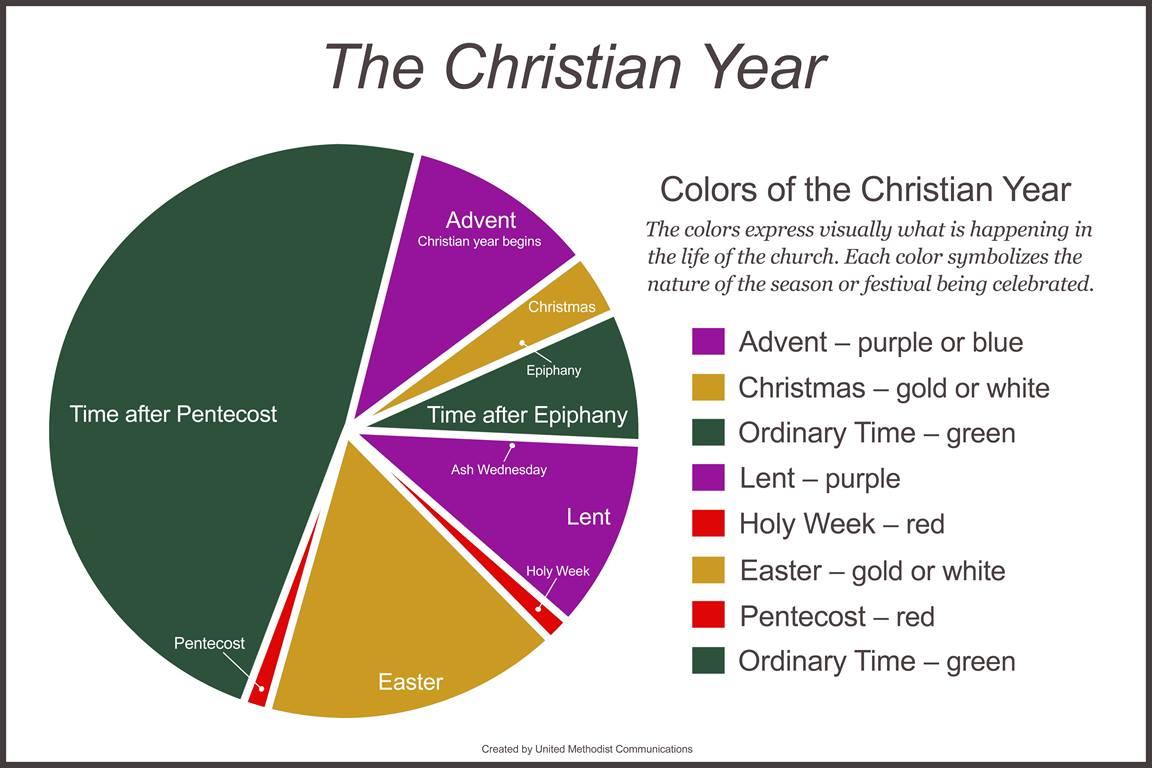
The Christian year includes the central seasons of Christmas and Easter followed by Ordinary Time. The colors associated with the different seasons express visually what is happening in the life of the church. Each color symbolizes the nature of the festival being celebrated. Graphic by Laurens Glass, United Methodist Communications.


The story of our salvation is retold every year through the observances in the Church Calendar. It begins with Advent (the coming) as we reflect on the Hebrew and Christian Scriptures.


John 3:16

God so loved the world that he gave his only Son, that whoever believes in him should not perish but have eternal life.


We look back in the Hebrew Scriptures to the prophet Isaiah who predicts what kind of a Savior the Father is sending us.


Isaiah 42:1-7


Behold my servant, whom I uphold, my chosen,

in whom my soul delights;
I have put my Spirit upon him;
    he will bring forth justice to the nations.
He will not cry aloud or lift up his voice,
    or make it heard in the street;
a bruised reed he will not break,
    and a faintly burning wick he will not quench;
    he will faithfully bring forth justice.
He will not grow faint or be discouraged
    till he has established justice in the earth;
    and the coastlands wait for his law.

Thus says God, the Lord,
    who created the heavens and stretched them out,
    who spread out the earth and what comes from it,
who gives breath to the people on it
    and spirit to those who walk in it:

“I am the Lord; I have called you in righteousness;
    I will take you by the hand and keep you;
I will give you as a covenant for the people,
    a light for the nations,
to open the eyes that are blind,
to bring out the prisoners from the dungeon,
    from the prison those who sit in darkness.


We turn to the Christian Scriptures to hear the story of the arrival of the Savior, Jesus Christ, as we celebrate the Feast of Christmas.


Matthew 1:18-23

Now the birth of Jesus Christ took place in this way. When his mother Mary had been betrothed to Joseph, before they came together, she was found to be with child from the Holy Spirit. And her husband Joseph, being a just man and unwilling to put her to shame, resolved to divorce her quietly. But as he considered these things, behold, an angel of the Lord appeared to him in a dream, saying, “Joseph, son of David, do not fear to take Mary as your wife, for that which is conceived in her is from the Holy Spirit. She will bear a son, and you shall call his name Jesus, for he will save his people from their sins.” All this took place to fulfill what the Lord had spoken by the prophet:

“Behold, the virgin shall conceive and bear a son, and they shall call his name Immanuel” (which means, God with us).                 

*************************

During the Advent/Christmas season, we try to bring the Spirit of Jesus into our current world. In the past, there were beautifully decorated churches, joyful Masses and Services, Christmas trees, gift-giving, random acts of kindness, cards or visits to relatives and friends, Christmas baskets and toys for the needy, Christmas shows, concerts, etc. 

This Christmas will be somewhat different. Rather than gathering together for Christmas parties, avoiding crowds and parties may be one of the best gifts we give one another to prevent the spread of the deadly virus.

However, we can still celebrate with the use of our creativity and technology. Virtual church services, Zoom gatherings, sending cards and gifts through the mail. With less money to spend, homemade cards and gifts may delight our loved ones. If you have the financial means, donating to help a family that does not have income would be appreciated. A telephone call might brighten someone’s day. 

Listening to Christmas carols can bring back happy memories. One of my favorites is ”O Holy Night.” Just taking the time to reflect on the words can bring Peace.”

‘O Holy Night’ is a timeless Christmas carol, composed by Adolphe Adam in 1847.

O holy night, the stars are brightly shining,

It is the night of the dear Saviour’s birth;
Long lay the world in sin and error pining,
'Till he appeared and the soul felt its worth.
A thrill of hope the weary world rejoices,
For yonder breaks a new and glorious morn;

Chorus
Fall on your knees, Oh hear the angel voices!
O night divine! O night when Christ was born.
O night, O holy night, O night divine.

Led by the light of Faith serenely beaming;
With glowing hearts by his cradle we stand:
So, led by light of a star sweetly gleaming,
Here come the wise men from Orient land,
The King of Kings lay thus in lowly manger,
In all our trials born to be our friend;

Chorus
He knows our need, To our weakness, no stranger!

Behold your King! Before Him lowly bend!
Behold your King! Your King! Before he bends!

Truly He taught us to love one another;
His law is Love, and His gospel is Peace;
Chains shall he break, for the slave is our brother,
And in his name, all oppression shall cease,
Sweet hymns of joy in grateful chorus raise we;
Let all within us praise his Holy name!

Chorus
Christ is the Lord, then ever! ever praise we!
His power and glory, evermore proclaim!


How are you going to make this Christmas special?


Have a Blessed Christmas and a Happy and Healthy New Year!


Comments:


Pat Chiaffa, ASBS

Our great and glorious God revealed his love for us by sending his beloved Son, Jesus, to dwell amongst us. Reverence, peace, and hope touch our hearts when we gaze upon the Nativity scene. We get a glimpse into the wonder of life. However, somewhere between the Stable and our return to daily living, many of us come to believe that Jesus came to respond to our personal needs. Rarely do we recognize that “Christ in our midst” is an “invitation from God inviting us to participate in God’s universal creative work,” as suggested by Father Richard Rohr.

In his letter to the Romans (19,22) St. Paul writes, “The whole of creation is eagerly waiting for the revelation of the sons and daughters of God…all creation is groaning in one great act of giving birth.”

Sr. Pat Bergen, CSJ, offers a present-day reflection on those verses, “all of creation is in labor waiting for us to wake up and realize the fullness of who we are called to be – Christ.” Sister is referring to Christ's consciousness. “To awaken to this consciousness is to awaken to the reality that the ‘breath of God’ is sustaining all that is. Therefore, everything belongs to and participates in God and God participates in all that is. This is Good News for the universe!”

No longer can I be content with passive contemplation of the loveliness of the birth event of the Redeemer of the world. I recognize that it is time for me to move beyond my “me-centeredness” to a sense of self that Sr. Bergen identifies as including “the whole cosmos – a sense of self that is one with God and one with all that is, was or ever will be.”

My prayer during this Advent and Christmas season is that I will discern the voice of Jesus as I ponder my response to the awareness of journeying into the fullness of Christ.

Let us adore the Christ Child by living in His love and rejoicing in the miracle of His birth. Sr. Annette, wishing you, your readers, and their loved ones, a blessed and peaceful Christmas. 


Stephanie Morris, Ph.D., ASBS, Historian, Certified archivist emerita

Our celebration of Christmas will be different this year for most of us.

Military families have been separated from loved ones for long periods and

often over holidays. We are fortunate that we can connect with family and friends

using technology. This season may be a little quieter and this may give us

some time to focus on the real meaning of Christmas.

We know "Jesus is the reason for the season" but how often do we talk to

the Infant King Who was born in poverty to give us the riches of salvation?

What gift did we get Jesus this year? A phone call to a shut-in relative or friend?

An extra Rosary for healing? Mother Katharine noted that Jesus came as an infant;

infants take small, "baby steps." We can take small steps in sharing

Christmas peace and joy with others.

Sunday, October 25, 2020

November, 2020 - Gratitude in Challenging Times

Psalm of David 138  (English Standard Version)

I give you thanks, O LORD, with my whole heart; 
before the gods I sing your praise;

I bow down toward your holy temple and give thanks to your name 
for your steadfast love and your faithfulness for you have 
exalted above all things your name and your word.

On the day I called, you answered me; 
my strength of soul you increased.

All the kings of the earth shall give you thanks, O LORD, 
for they have heard the words of your mouth,

And they shall sing of the ways of the LORD, 
for great is the glory of the LORD.

For though the LORD is high, he regards the lowly, 
but the haughty he knows from afar.

Though I walk in the midst of trouble, you preserve my life; 
you stretch out your hand against the wrath of my enemies, 
and your right hand delivers me.

The LORD will fulfill his purpose for me; your steadfast love, O LORD, 
endures forever. Do not forsake the work of your hands.


Welcome to November 2020. This month we face many challenges: a very difficult election season, living within a pandemic with all its problems, and a Thanksgiving which may need to be celebrated in new ways.

What all this calls to my mind are some experiences I had when I was assigned to teach at Xavier University in New Orleans, Louisiana, a historically Black Catholic University, founded by St. Katharine Drexel. Sister Ivan, a Sister of the Blessed Sacrament, was concerned that I know about the rural areas from which some of Xavier’s students came. Therefore, she took me to Church Point, a small town where some of our Sisters ministered. I was looking forward to the visit, but did not realize the lessons I would learn on that trip.

After showing me the small parish church and convent, she took me to visit an elderly couple who lived nearby. Their home was a tiny wooden house which was in very poor condition. However, we received a warm reception in the midst of bursts of praise and thanksgiving to God. I heard no complaints. Instead, the conversation was continually punctuated with expressions of praise and thanksgiving to the Lord. That was the first lesson I learned. 

Then, while I taught at Xavier, I also became involved in campus ministry and was with the young people during their prayer time. They echoed the joyful spirit of their elders as they spontaneously praised and thanked God, in spite of some very difficult circumstances from which they had come. This included thanking God for waking them up in the morning!!!

I am not a morning person!! However, to this day, when I struggle to get out of bed, I try to remember to thank God for “getting me up in the morning.” Sometimes, teachers learn from their students too.

*******************

These days are very difficult for just about everyone, some even more than others. However, an attitude of gratitude can lift one’s spirits and help one through troubling times.

In the booklet, Our Daily Bread, I read the story of Martin Rinkart, a clergyman who served in Saxon, Germany, for more than thirty years during a plague and wars in the seventeenth century. In one year, he conducted over 4000 funerals, including that of his wife. Because of food shortages, often his family went hungry. However, he had a strong faith in God, and he continually gave thanks to him for what they did have. He even composed a hymn of gratitude, still popular today: “Now, thank we all our God.”

With the realization of the circumstances during which the hymn was written, it might be meaningful to reflect on the verses to the hymn:

Now thank We All Our God

1

Now thank we all our God
With heart and hands and voices,
Who wondrous things has done,
In whom his world rejoices;
Who from our mothers’ arms
Has blessed us on our way
With countless gifts of love,
And still is ours today.

2

O may this gracious God
Through all our life be near us,
With ever joyful hearts,
And blessed peace to cheer us;
Preserve us in his grace,
And guide us in distress,
And free us from all sin,
Till heaven we possess.

3

All praise and thanks to God
The Father now be given,
The Son and Spirit blest,
Who reigns in highest heaven;
Eternal, Triune God,
Whom earth and heaven adore;
For thus it was, is now,
And shall be ever more.


God has many kinds of flowers in His garden. Not all of us can compose hymns, but we all can express our gratitude to God in our own unique ways. Some common ways are the following:

  • Writing poetry
  • Journaling
  • Painting/Drawing
  • Helping someone in need
  • Forgiving someone
  • Giving something to those in need
  • Donating to an organization helping others
  • Volunteering to help those in need
  • Listening

There are many other ways to show gratitude to our Lord and others. If you would like to share some comments or suggestions on gratitude, send them to me at srannettemarie@gmail.com during the month of November.


Comments/ Suggestions:

Stephanie Morris, ASBS. Ph.D. Historian, Certified Archivist, Emerita

Mother Katharine wrote that “The ordinary soul does not do enough thanksgiving. For all eternity I shall sing the mercies which we ought to begin on earth.”  We can sing of God’s mercies when we see a beautiful sunrise or sunset. A comfortable, sunny day can lift our hearts in praise and gratitude. It doesn’t have to be a lengthy aria; a short aspiration – Thank you, Lord, for bringing me safely home from my errands – can be a joyful song of praise. Do you say grace before or after meals? This is another simple way of showing gratitude. You might also thank the cook! If you, like me, did the cooking, we can thank those who grew or provided the food and we can thank God for having the means and skills to prepare the meal.

Sunday, October 4, 2020

October 2020 - Psalm 23

 Psalm 23: The Lord Is My Shepherd (ESV)


The Lord is my shepherd; I shall not want.

He makes me lie down in green pastures.

He leads me beside still waters.

He restores my soul.

He leads me in paths of righteousness

for his name’s sake.

Even though I walk through the 

valley of the shadow of death,

I will fear no evil,

for you are with me;

your rod and your staff, they comfort me.

You prepare a table before me

in the presence of my enemies;

you anoint my head with oil;

my cup overflows.

Surely goodness and mercy shall follow me

all the days of my life,

and I shall dwell in the house of the Lord

forever.


One of my favorite Psalms is Psalm 23 (22 in some translations). Many years ago, I was introduced to it by my teacher in a public elementary school. Our teacher began the day with our saluting the flag and then reciting Psalm 23 together. It has remained a source of inspiration and comfort throughout my life.

While I ministered in the Navajo Nation, I was blessed with the privilege of observing shepherds caring for their sheep. I also remember one shepherdess sharing that she was getting older and did not know how much longer she could care for her beloved sheep. She was discerning which one of her family members to whom she would entrust the care of the sheep when she could no longer give them the love and attention they needed. Her concern was that she choose one who would become a good shepherd or shepherdess who would be watchful, patient, and have a special, caring relationship with each individual animal.

Sheep are very dependent on their shepherds and sheepdogs (sometimes llamas) because of their limitations.  Sheepdogs, e.g., Australian Shepherd dogs, are very intelligent. I have observed them helping the sheep cross a road safely.

******************************

Psalm 23 is believed to have been authored by David around 1000 B.C.  Let us pause to listen carefully to the words:

The Lord is my shepherd: I shall not want He makes me lie down in green pastures. The shepherd seeks out good pastures for the sheep to graze and leads them there. 

He leads me beside still waters. Since sheep are easily frightened, the shepherd avoids loud waterfalls and finds quiet waters so they can drink peacefully. He restores my soul.

He leads me in paths of righteousness for his name’s sake.

Then, the psalmist says the Lord also guides him in the ways of “righteousness” (goodness).  

Even though I walk through the valley of the shadow of death, I will fear no evil for you are with me; your rod and your staff. They comfort me. 

Some of the paths the sheep have to travel to be pastured are very dangerous.  There are steep mountains to climb and treacherous valleys, but the sheep are never alone.

The staff, like a cane with a rounded hook, is used by the shepherd to test the ground ahead of the sheep to see if it is secure. Sometimes the brush on the side of the mountains hides the danger of loose rocks and the edge of the cliffs.  The shepherd guides the sheep away from the precipices. However, sometimes a wandering sheep loses its way and becomes caught in the brush or slips into a crevice. The shepherd can sometimes rescue the sheep, using the hook end of the staff. (Today, Bishops carry a staff to symbolize that they are to be shepherds of their flock.)

The rod, a thick stick or bunch of twigs, is used to ward off dangerous animals who might attempt to harm the sheep. It can also be used to push back thick brush in the pathway: the rod and the staff help to make the sheep feel safe. The shepherd provides a safe and pleasant pasture for the sheep by watching for dangerous animals and being prepared to get rid of them so the sheep can graze peacefully.

You anoint my head with oil;

Unlike some animals, the sheep cannot rid themselves of insects who might attack their heads, so the shepherds rub their heads with oils that ward off insects.

My cup overflows.

The sheep’s hearts are overflowing with happiness.

Surely goodness and mercy shall follow me all the days of my life,

Having such a loving and caring Shepherd as the Lord, he trusts that he will be cared for in this life.

And I shall “dwell” in the house of the Lord forever.

When called to his heavenly home, he exclaims that he will live joyfully with his Shepherd Lord forever.


Comments:

Stephanie Morris, ASBS, Ph.D. Historian, Certified Archivist, Emerita 
The Infant King was first manifested to shepherds. Shepherds were not the elite of Jewish society. They worked outdoors and their duties were 24/7 - sheep needed care every day. No matter our own status, each of us is called to be a shepherd. We can guard any soul entrusted to us, guiding them to a closer relationship with God. We can guide anyone we meet to a more joyful, peaceful relationship with God. This is a 24/7 call - we never know when the Holy Spirit might prompt us to do something - large or small - for someone.


Pat Chiaffa, ASBS

Psalm 23 has been a source of comfort to me since I was a child. My parents divorced when I was eight-years old; my world was turned upside down. I had to get used to living without my dad and shortly thereafter, adjust to living with a stepfather. The situation left me very frightened.  I would close my eyes and call to mind the gentleness of the shepherd and pretend I was the sheep he placed on his shoulders. It brought me great peace. That same meditation comforts me today as I struggle to grasp the fragile reality of our world. I find myself distressed over the lack of leadership across the globe, the growing violence, shattered economy, crushed dreams and the plight of so many displaced people. I am saddened beyond words at the fear (of Covid 19) that is paralyzing countless people, contributing to anxiety and depression and the loss of bonds of connection and spiritual nourishment. This past weekend I was on a retreat which annually welcomes three hundred participants, the majority of whom have been coming for decades. This year the count was under thirty. Two hundred, seventy women missed powerful messages of God’s tender love, compassion and mercy, and the opportunities to relax, reset and receive the dynamic inspiration that is palpable in such a Spirit-filled environment. 

I believe that the Good Shepherd is calling us to co-shepherd our fellow “sheeples” during these turbulent times. In spite of masking up, we need to speak out of the Presence of God and reach out with words of encouragement and hope. The Presence of God is invisible as is the virus. Yet, the media sustains fear by bombarding the public with details of the virus. It is a challenge to turn off the media info etched in our heads long enough to enter into a quiet place to pray and find rest and hear the gentle whispering of the Holy Spirit to soothe our troubled souls. We need to communicate the message of faith by focusing on and expressing the love, Presence and power of God. Faith drives out fear. The image of the Good Shepherd as described in Psalm 23 is a very effective meditation to foster peace, restore calm and trust in God’s loving Providence.