Thursday, July 28, 2016

July 31, 2016 - Seek the Things That Are Above

  
The Eighteenth Sunday in Ordinary Time 
Year C


Image result for seek ye first the Kingdom of God
                       
                                                   Reading I: Ecclesiastes 1:2; 2:21-23
                                                   Responsorial Psalm: 90:3-6, 12-14, 17
                                                     Reading II: Colossians 3: 1-5, 9-11
                                                            Gospel: Luke 12:13-21

In Louisa May Alcott's book: Little Women, Ch. 40, she says, “Love is the only thing that we can carry with us when we go....”  Since in heaven we will see the Lord, we no longer need faith or hope. Love is what is eternal. When we die, our possessions, our titles, our accomplishments are left behind. The legacy we leave is only of worth if it is the fruit of our love on earth. What we take with us is the quality of our love.

In our world today, often a person’s worth is measured by his/her possessions, titles, and accomplishments. The Lord wants us to see with different eyes. An elderly Sister friend of mine used to worry about her niece Frances who was in a mental institution.  Frances was a normal child until at the age of five. Then, she fell off a high porch and suffered brain damage. She developed severe epilepsy at a time when medications could not help. She was an only child, so when her parents passed on, she was placed in an institution with people who had serious mental problems.  The aunt was the only relative who would visit her. When my Sister friend was close to death, she shared with me her concern that her niece would no longer have visitors once she went home to God.  I offered to visit Frances when I could.

One time when Frances had fallen and broken her arm, I was expressing my sorrow that she had to deal with the pain and inconvenience.  Her response surprised and edified me: “Jesus suffered for me, so I can offer my suffering to him.” She would always take the time to introduce me to the other patients. I could tell by their responses that she was well-liked because of her kindness to all. Frances died at about 65 years old after about 60 years in an institution.  She had no possessions, no titles, no accomplishments by worldly measure. However, she had shared love. That was all her heavenly Father asked of her.

Another lesson I learned occurred when I was serving as a parish minister in a remote mission in Many Farms, Arizona on the Navajo Reservation. There was an elderly man from the East who intended to leave his money to the Missions when he died. He had been a contractor and had accumulated a large amount of money. He was advised to give the money to the missions while he was still living and visit those missions he was helping.

When he arrived at Many Farms, I served him dinner. As we were eating, he shared his story. He had an adult son who had been bedridden and unable to talk all his life. All he could do was hug people. This gentleman taught religion classes in his parish. Each year, he would have his healthy sons help him to bring the invalid son to class. The lesson was to see what is most important in life. The father would simply say. “All my son can do is love.” What a powerful lesson that was! Again, this young man had no possessions, titles, or worldly accomplishments. However, he had done what was most important: he had expressed love.

It is so easy for us to get our priorities out of order.  We are bombarded with advertisements which encourage us to accumulate items which are wants rather than needs. Our time can be squandered on things that are unnecessary. Let us ask the Lord to help us to keep our priorities in order. Perhaps, as we listen, we may find that we need to make some adjustments.
                                                             
                                                            *************

St. Katharine Drexel challenges us to relish what is of lasting worth in her encouraging words: “Let your heart delight in the love your God has for you, personally, individually.”

Friday, July 22, 2016

July 24, 2016 - Lord, Teach Us to Pray


The Seventeenth Sunday in 
   Ordinary Time - Year C


First Reading: Genesis 18: 20-32

Response: Psalm 138

Second Reading: Col.  2:12-14

Gospel: Luke 11: 1-13


In the face if recent tragic events in our world and in our Nation, we often feel helpless. Father Ron Rolheiser, OMI, presents a remedy in his article The Power of prayer and Ritual Inside Our Helplessness. He refers to a movie based on Jane Austen’s classic novel, Sense and Sensibility. A young woman is lying close to death from pneumonia while a young man who loves her is pacing back and forth frustrated by the fact that he is helpless in the situation. He asks her mother what he can do to help the sick woman. Heart-broken he cannot accept the response that there is nothing they can do. He then cries out: “Give me some task to do, or I shall go mad!”

Many of us experience these feelings in events of our personal lives, as well as in the other times of crisis. There are two helpful ways of dealing with them: prayer and action. I remember the many times that I was called to Maristhill Nursing Home where my father was residing. I would be told that there was a possibility that he might be nearing death. Usually, one of the Sisters would drive me. Instinctively, I would reach for my rosary and finger it on the way. Then, when my mother died, I wanted to pass on the love and wisdom that my mother had given to me. Having no children of my own, I joined the Big Sister Association and mentored two young girls. That action helped not only the children, but also helped me to deal with the loss of my mother.

We often see good evolve from tragedy. Maybe that is why the Lord allows these difficult and heart-wrenching events. In times when people realize things are out of their control, they often turn to God. How many people after a divorce, a health crisis, the death of a loved one, a devastating weather catastrophe, or in the midst of the terrors of war, turn to their Creator in prayer? How many acts of kindness, tributes, memorials, support groups, fundraisers, scholarships and philanthropic foundations, result from the need to do something positive on the heels of a tragedy?

A current example of this is being initiated by the National Black Catholic Congress (NBCC) which is responding to the terrible epidemic of violence in our Nation and throughout the world in the following manner:

Baltimore, 13 July 2016: The National Black Catholic Congress (NBCC) joins the nation in mourning over the tragedies in Baton Rouge, the Minneapolis-Saint Paul area, and Dallas last week. As we commend to the Lord those who have died, we pray for the consolation of all who are grieving.

It is important for Black Catholics to contribute to the ongoing national conversation about the underlying issues which have existed for too long. These issues include racism, inequality, poverty, and violence. During this Jubilee Year of Mercy, we must be signs of God’s love which promotes justice. Justice promotes right relationships, which includes upholding the dignity of human life.

The NBCC invites Black Catholics and all people of good will to join in a time of prayer and action. We believe in the power of prayer. We also believe that we must cooperate with how God will answer our prayers. HENCE, THE NBCC ASKS YOU TO JOIN US IN OFFERING THIS PRAYER FROM MONDAY, JULY 18TH TO MONDAY, AUGUST 15TH:

       
O God, who gave one origin to all peoples and willed to gather from them one family for yourself, fill all hearts, we pray, with the fire of your love and kindle in them a desire for the just advancement of their neighbor, that, through the good
things which you richly 
bestow upon all each human person may be brought to perfection, every division may be removed, and equity and justice may be established in human society. Through our Lord Jesus Christ who lives and reigns with you in the unity of the Holy Spirit, one God forever and ever.                              


Collect - Votive Mass for the Progress of Peoples from the Roman Missal


In addition, Friday is a day of penance for Catholics throughout the year. During this same period, we invite Black Catholics [and others] to make a sacrifice of your choosing on Fridays to accompany our prayers for justice with acts of reparation.  What positive action do you think the Lord may be asking of you?

Friday, July 15, 2016

July 17, 2016 - Martha and Mary, Friends of Jesus

The Sixteenth Sunday in Ordinary Time 
Year C


First Reading:  Gen. 18: 1-10

Response:  Psalm 15

Second Reading: Col. 1:24-28

Gospel:  Luke 10: 28-42

I just love the intimacy reflected in this picture of Jesus and his close friends. Martha appears exhausted as she shares the frustration that she has been running around providing hospitality while her sister Mary simply sits in adoration at the feet of Jesus. Martha is able to tell Jesus exactly how she is feeling. Probably, Jesus detects some jealousy as she complains about her sister.

Martha most likely expects to have Jesus come to her aid by telling Mary to go to the kitchen to assist her sister. While Jesus had obviously listened to Martha with compassion, he gently admonishes her by saying that she has indeed been "busy about many things." However, he tells her that Mary's decision to remain in his presence and to simply listen to him is the better "part." 

Being "part" implies that it is not the whole. The hospitality is important also. Both
prayer and action routed in the prayer are important in the life of a follower of  Jesus. The challenge for me is often finding the balance. 

However, I do not believe I am alone in my struggle. Ironically, back in the 70's when I was teaching college English, we were told that the time was coming that people would only work four days a week and needed to learn positive ways of using their leisure. Obviously, the prediction did not turn out to be correct. For many different reasons, most people today work more than ever. Finding time for for even the necessary things can be difficult, let alone leisure time.

Balancing prayer, work, family, community, civic responsibilities, church activities, social life, and self-care is challenging. Each of us must find his/her own way, with the help of the Lord, who knows and understands us completely. 

Perhaps, by expressing all of our innermost feelings like Martha and listening attentively like Mary, we will be able to find the correct balance for ourselves. We all have our own unique personalities, talents, limitations, and circumstances. Since the Lord knows and loves us better than we know or love ourselves, he can guide us. On our part, we need to seek his help, open our hearts, listen deeply, and follow his inspirations.
  

Friday, July 8, 2016

July 10, 2016 - The Good Samaritan


The Fifteenth Sunday in Ordinary Time 
Year C

1st Reading: Dt. 30: 10-14
Response: Psalm 69
Second Reading: Col. I: 15-20
Gospel: Luke 10: 25-37

Over the years, the expression “a good Samaritan” has become a popular description of a person who goes out of  his or her way to help someone in need.  It is indeed an appropriate way of describing a kind person’s response to someone in need. However, it has become so commonplace that it does not fully describe the heroic courage of the person presented by Jesus.

First of all, Samaritans were despised by the Jews because they had intermarried with non-Jews and were worshipping pagan gods. Theirs was a mixed culture including Jewish and Gentile aspects. Because of prejudice, this Samaritan risked not only distain, but possible violence because he chose to help this Jewish man while others passed him by. 

Nonetheless, this compassionate man not only bound up the wounds inflicted by the robbers, but he placed him on his own animal. Together they managed to carry wounded man to an inn. After the laborious trip, the Samaritan left the injured man in the care of the innkeeper so that he could receive the shelter, food and care he needed. That was not enough! He planned to check on him on his return from his journey and to pay the innkeeper for any expenses incurred. This Samaritan is motivated by love and compassion, not just for his own people, but for a suffering brother in the family of God. 

I recall being reminded in the past that in God’s garden, there are many types of flowers. They have their own colors, shapes, sizes, and fragrances. The variety adds to the beauty of the display. Whether we differ in race, nationality, appearance, faith, ability, talents, personalities, sexual preferences, or political persuasions, we are all children of our Heavenly Father who loves each one of us as we are. This Samaritan saw the injured man as his brother. That is what made all the difference!


Friday, July 1, 2016

July 3, 2016 - The Harvest Is Plenty

The Fourteenth Sunday in Ordinary Time Year C


Reading I:
Isaiah 66:10-14c
Responsorial:
Psalm 66
Reading II:
Galatians 6:14-18
Gospel:
Luke 10: 1-12, 17-20

As I reflect on the massive field, I am struck by the few laborers who are attempting to reap all the wheat. It certainly must have been backbreaking work. I can imagine that they must have developed painful conditions in their backs, with the daily, long hours in the field and the constant bending over in the hot sun.

All the while, they must have encountered wild animals and been annoyed by insects, as they toiled with little reward for their hard work. However, they probably had no other option for making a living, so they had to continue in spite of the pain and weariness.

Love has to be a choice; therefore, he gave us free will. His call is an invitation which we can accept or reject. We, who wholeheartedly accept the invitation, must be willing to be among the few. We must face the challenges, the weariness, and the pain involved. However, experiencing the companionship and support of the Lord and other dedicated followers, we are truly blessed!!!

The feet of the workers must have been extremely painful from standing on them for so many hours a day. Also, the laborers must have experienced intense joint pain in their hands from the repetitive motions they had to perform for long periods of time.

In this Sunday’s Gospel, Jesus tries to enlist helpers as he goes about his ministry of spreading the good news of salvation. Of course, there was no Internet or TV in his time. They, too, had to endure hardship in their ministries. He and his disciples had to travel mostly by foot, animal, or boat to deliver the message of God's great love to the people. While they were encouraged by the enthusiastic response of some, they also encountered hardship. Sometimes, they were rejected; other times they experienced weariness, discouragement, and pain. They were so few...among so many.

It seems that the Lord would call enough people to take care of the harvest of souls. However, he chose not to force us to follow him.

St. Katharine Drexel earnestly urges us on with these words:
“Follow Him as witnesses of Him, strong in His Power.

Friday, June 24, 2016

June 26, 2016 - The Challenging Jesus


  The Thirteenth Sunday in Ordinary Time  Year C

                                                        Reading I: 1 Kings 19:16b, 19-21
                                                 Responsorial Psalm 16:1-2, 5, 7-8, 9-10, 11
                                                         Reading II: Galatians 5:1, 13-18
                                                                  Gospel: Luke 9:51-62


Looking at the men Jesus is inviting to follow him, I see questioning, hesitation, uncertainty.  
Jesus, rather than trying to persuade them, challenges them: “Foxes have dens and birds 
of the sky have nests, but the Son of Man has nowhere to rest his head.” One says that he 
wants first go bury his father. The other asks to first go home to say farewell to his family.
Jesus wants them to leave all immediately to go to proclaim the kingdom of God. I am struck
by the intensity of Jesus as he calls them.

As I reflect on the Gospel for this Sunday, a quote from Soren Kierkegaard that what Jesus
wants is “followers not admirers” strikes me deeply. It is so, so easy to admire Jesus.  To follow
Him requires much sacrifice. I find that one of my favorite prayers is “Lord, help me to love 
you as you deserve to be loved.” As I ask myself if I am an admirer or a follower of Jesus, 
sometimes I am not sure.  

Yes, I do attempt to imitate Jesus when I ask myself: What would Jesus do in this situation?
What is the truly loving thing to do? Sometimes there is a feeling of happiness and fulfillment
when we extend ourselves in loving God and our brothers and sisters. However, there are
other times when we only feel sacrifice in putting away our own desires in the context
of self-forgetful love. 

Married couples must learn to compromise and give up some of their own ways for the sake
of a good marriage. Caring parents learn sacrifice when they put aside their own desires for the benefit of their children. I learned sacrifice when I chose to visit my father who had Alzheimer's disease, even after I had realized that he didn't even know who I was. There is sometimes no sense of personal comfort in sacrifices. My experience has helped me understand what is often involved in dedication: the surrender of one's own comfort and/or desires for the good of others.

Jesus certainly put aside his own comfort and humbled himself to take on our humanity and live as a human being with us. This endears him to us. Certainly, he made many, many sacrifices in his lifetime and ended it with the supreme sacrifice at Calvary. The pain of others weighed heavily on his compassionate heart. He was especially aware of the heartbroken state of his mother who
shared so profoundly in his sufferings.

If we are to follow Jesus, rather than simply admire him, sacrifice must be a significant part of our lives. As humans, we usually do not like to sacrifice. Even Jesus struggled in the Garden of Olives before his Passion saying: “Abba, Father, all things are possible to you. Take this cup away from me, but not what I will, but what you will.” (Mark 14:36)

It is only with the strength of the Lord that we, humans, can follow and imitate the Jesus. We need to pray to the Holy Spirit whom Jesus sent to help us when being a faithful follower of Jesus seems to be beyond our natural ability.


Friday, June 17, 2016

June 19, 2016 - The Merciful Jesus


 The Twelfth Sunday in Ordinary Time 
                                        
        Original Painting by Eugeniusz Kazimirowski 
               following Sr. Faustina's instructions

The picture above was painted by the gifted artist, Eugeniusz Kazimirowski. This artist was hired to paint the picture of  the merciful Jesus as was seen in a vision by St. Faustina. Jesus had commissioned her to disseminate the devotion to Divine Mercy.
In the painting, we can see rays representing the blood and water pouring forth from the heart of Jesus. This fountain of mercy's purifying u
s was foretold by the prophet Zechariah and recorded for us in the Hebrew Scriptures.
Periodically, the Lord must remind us of his total unconditional love. Since we, limited creatures, often show love with conditions, it is difficult for us to even conceive of the breadth and depth of our God's love. Centuries ago, Jesus reminded us of  the immense love of God when He appeared to St. Margaret Mary Alacoque, showing her his heart burning with love. That picture of Jesus with loving heart exposed has comforted many
generations.


Today, the Divine Mercy Picture gives us the same message. In a time when hatred is

so prevalent in our world, Jesus reassures us of his great love. He also gave to St. Faustina a beautiful chaplet to pray. It is a simple prayer and can be prayed on a
regular rosary:
 
1. Make The Sign of the cross, the Our Father, Hail Mary, and the Apostle's Creed. 
2. Say on the Our Father bead at the beginning of each decade the following prayer: Eternal Father, I offer you the Body and Blood, Soul and Divinity of Your
dearly beloved Son, Our Lord, Jesus Christ, in atonement for our sins and those of the whole world.

3. On the ten small beads of each decade say the following prayer: For the sake of His sorrowful Passion, have mercy on us and on the whole world.

4. End with the following prayer and the sign of the cross. 

Holy God, Holy Mighty One, Holy Immortal One, have mercy on us and on the whole world.           

          
In the Gospel of Luke 9:18-24, Jesus asks his disciples who they personally believed he is. Peter professes his belief that Jesus is "the Christ". Like a diamond or crystal, depending on the angle one views it, various colors shine forth. Each reflects a part of the whole. Pope Francis this year is asking us to focus on the Mercy of  God. His response to that question might be "You are the Merciful One." If Jesus were to ask you today who he is, what would be your response?

Perhaps, we could take some time to contemplate the Divine Mercy Painting and allow the fountain of mercy pour over us to cleanse and heal us. Let us give humble thanks for our awesome God and our priceless gift of faith.


Friday, June 10, 2016

June 12, 2016 - The Eleventh Sunday in Ordinary Time: The Forgiving Jesus


Year C:  Reflections on the Gospel of Luke 7:36-50


I have always been touched by the sinful woman's courage.  Propelled by intense love of for Jesus, she ignores the comments and disdainful glances of the Pharisees at Simon's banquet.  She humbly kneels at the feet of her Lord, washes them with her tears, dries them with her hair, gently kisses them, and lovingly anoints them.

Jesus, with great compassion, simply sits there allowing this despised woman to minister to him.  He graciously accepts her demonstration of sorrow and love.  He bends over to place his healing hand on her to reassure her of his love and forgiveness.  He does this  despite the ridicule of the bystanders.  What joy the sinful woman must have felt!  What peace! How she must have cherished this moment for the rest of her life.

How grateful the woman must have felt as he responded to the belittling remarks of the men.  He actually defended her and expressed his appreciation for her great love!  God is grateful for the imperfect love of his creature!!!  How can this be?  He must be absolutely crazy about us weak and sinful humans.That is something we need to pause over, savor, and ponder within our hearts.

                                                              ************

For many years, I and others associated this happening with Mary Magdalene.  However, recent Biblical scholarship does not support this.  The association might have happened because the passage following this story mentions Mary Magdalene as being among the women following and supporting Jesus out of their own resources.  The mention of demons being driven out of her could well mean an illness.  At the time, illnesses were often viewed as possession by demons.  Jesus attempted to correct that notion in relation to the man born blind. When the question was asked whether it was his sins or the sins of his parents that caused the blindness, Jesus responded that it was neither. Jesus explained that he was born blind so that the works of God might be displayed in him.

                                                            ************
St. Katharine Drexel, in her journals, reminds herself  [and us] to believe in Him and the power of His words,"Woman thou art healed and in that same instant she is healed."

Friday, June 3, 2016

June 5, 2016 - The Tenth Sunday in Ordinary Time


Year C :  Reflections on the Gospel of Luke 7:11-17


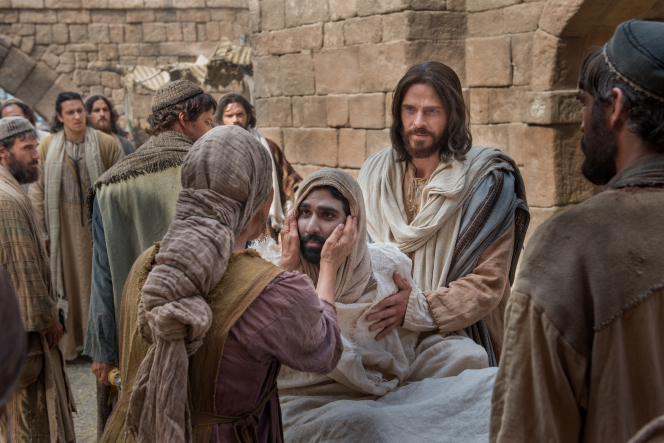
Luke 7:11–16, Christ raises a young man from the deadIn today's Gospel, we see a compassionate Jesus. He observes the dead young son of a widow being carried on a bier, along a dirt road, leading to the grave. He is her only child. Not only does she grieve his passing, but he is her only source of support in a time when women depended on male family members to care for them. Jesus' heart goes out to her in her great loss.

Jesus could well be also envisioning the day when his own mother would be heartbroken over the cruel death of her only son. He is touched to a degree that he chooses to raise the son from the dead. What great joy the mother is experiencing, as depicted in the picture above! What happiness Jesus must feel to be able to return the beloved child to his mother!  

Maybe Mary was there that day.  Did she understand that Jesus was trying to reassure her that even though she would see him die at the hands of sinful men,  he would also rise from the dead?  Did she have a sense of the joy that would be hers on that blessed day, as she watched the widow tenderly cup her son's face in her hands?  Were some of the disciples present to observe this miracle?  Were they able to trust that Jesus would come back to them also?

We can observe how Jesus sensed the heartbreak of the widow and how he responded to her great sorrow and need.   However, the witnesses seem puzzled.  Who is this Jesus, the son of a carpenter, who can raise a person from the dead?  Were some resentful of all the attention Jesus'  kindness and power brought to him?  Are they feeling jealous that people are following him?  He seems so very ordinary, yet he does extraordinary things?  Where does he get his power?    Do they feel drawn to follow Him and imitate his compassion in their own lives?  We can only speculate about all these things.  However, allowing ourselves to contemplate the scene,  can deepen our appreciation of the Lord and His followers.

Today we observe the compassionate Jesus who told us that he is "the Way, the Truth, and the Life." Are we willing to live His Way? Do we make the necessary sacrifices to extend compassion to our brothers and sisters in need?  With the Lord at our sides giving us strength, we can let go of our self-centered ways and embrace His Way.

Among St. Katharine Drexel's writings we find the following: "I firmly believe that we don't realize the power that is ours in the Companionship which is ours." Who needs our compassion at this time?

Friday, May 27, 2016

Reflections on the Feast of Corpus Christi

Feast Day of the Sisters of the Blessed Sacrament


    This is a special day for the Sisters of the Blessed Sacrament. St. Katharine Drexel, the foundress of the Community, and her family were very devoted to Jesus in the Blessed Sacrament. They even had a chapel in their home where daily they spent time in adoration of the Lord. However, Kate, as she was called by her family, had a broader view of the Eucharist than many of her contemporaries. She saw in the Eucharist the mystical body of Christ, including all peoples.  

    Often, missionaries came to her home to ask for money for the Indian Missions which were in dire need. Her family regularly helped to support the missions and Catherine* had a special concern for the spiritual and physical welfare of the Native peoples. They were suffering from having their lands taken from them and being placed on Reservations, where it was sometimes difficult to grow food and obtain other necessities.

    At Kate's time in history, slavery had recently been abolished, but the slaves had little education and could not find jobs. Some even went back to work for their former owners. Several days a week, she and her sisters helped to distribute food, clothing, rent money, etc. to those in need. Thus, at a young age, she and her sisters became aware of the plight of many African Americans in Philadelphia and other parts of the country. 

  On a trip to Europe, Catherine had an audience with Pope Leo XIII  during which she begged him to send more missionary priests to help the Native American people. The Pope's response to her was "Why don't you yourself become a missionary?" Catherine had been considering becoming a contemplative nun, but had not thought about becoming a missionary. However, she took this suggestion as a sign that God was asking her to care for His suffering children. Thus, she founded the Sisters of the Blessed Sacrament for Indians and Colored Peoples. The Community is dedicated to the building of unity and community among all peoples.

*St. Katharine Drexel was born Catherine Mary Drexel, and later chose the name Sr. Mary Katharine as her Religious Name.